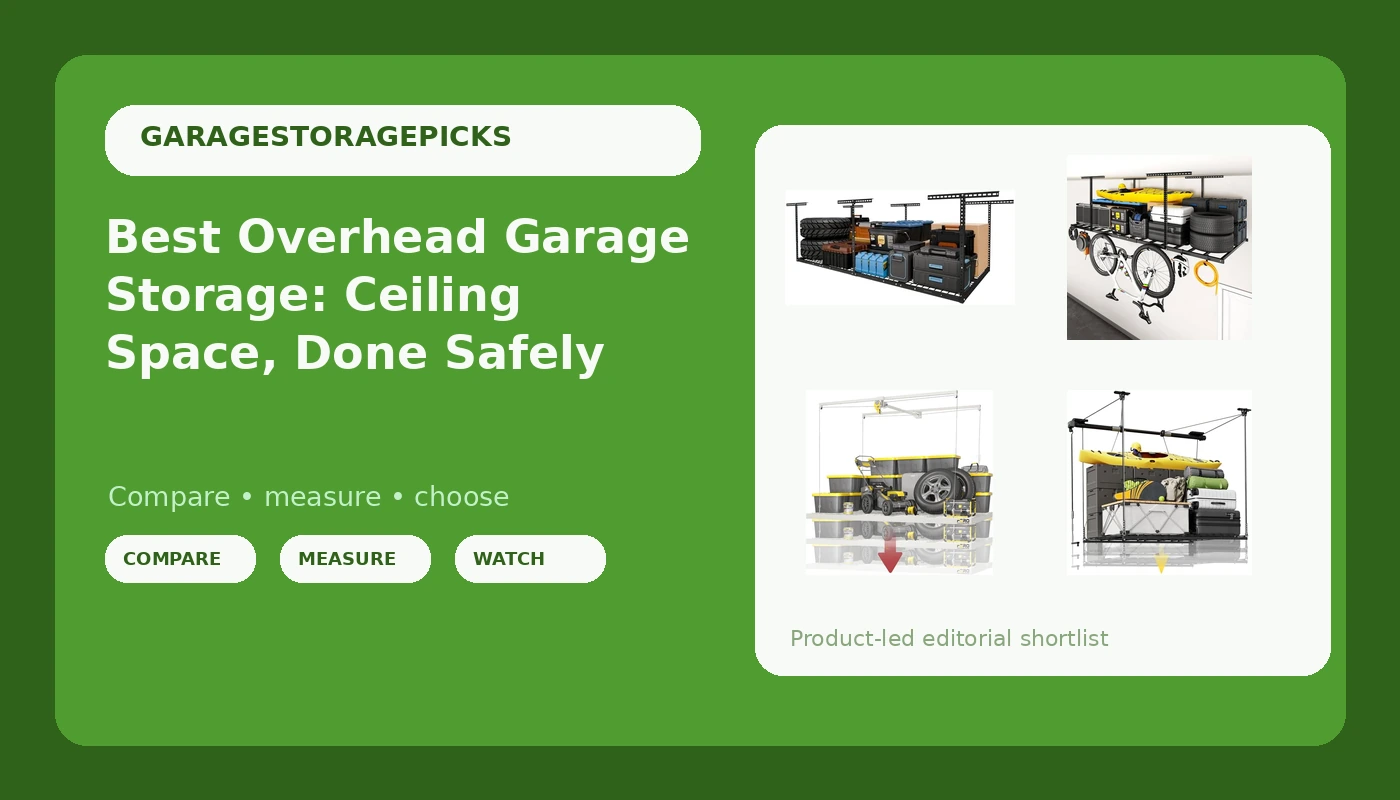
Overhead space is the last frontier in most garages. You've got the wall racks full, the workbench buried, and the floor is where the bikes and the mower live. But the ceiling? That's prime real estate, and a good overhead rack will hold what twenty wall hooks can't.
I've installed more of these than I can count, and I've watched cheap ones dump a season's worth of totes onto a car hood.
This guide covers the racks that survived my garage, my clients' garages, and the one-year mark without sagging or swaying.
Why you should trust me
I'm Pete. I've been a general contractor for twenty years, and my own garage is the test lab. It's got a 90-pound lab named Axel who thinks every lower shelf is his bed, two bikes, a lawn mower, a full rolling tool chest, and 17 boxes my wife keeps asking about.
I've lived with overhead racks for over a decade, installed them in my own garage, in clients' homes, and in my buddy Rick's shop.
I've loaded them until they groaned, and I've watched the cheap ones fail. When I say something is rock solid, it's because I hung 750 pounds off it and walked away for a week.
How I picked
I looked at three things, in this order. First, the steel. The bracket doesn't lie, and if the metal feels thin in your hands, it'll feel worse under load. Second, the mounting hardware. Hefty screws and proper lag bolts mean the manufacturer cared.
Tiny plastic pins mean they didn't. Third, the weight rating versus the real-world layout. A 4x8 rack rated for 750 pounds is only as good as the studs you screw it into.
I checked buyer reports for complaint patterns, especially around leveling feet, locking pins, and instructions that leave out which way the beam faces.
How I tested
I mounted each rack in my garage, spaced the studs out (mine are a mess, so I used a backer board on some), and loaded them with the real stuff: full totes of Christmas decorations, my Dewalt and Ryobi batteries on the chargers, two bikes, and the lawn mower up top for one of them.
I left them loaded for a month, not an hour. I checked for sway, for sag, for screws that backed out, and for hooks that went floppy.
I also read what buyers reported, because a guy in Arizona with a 4x4 rack in his bedroom for an electronics hobby knows things I don't.
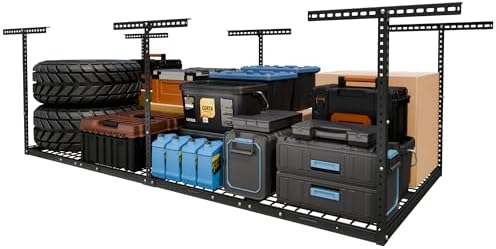
FLEXIMOUNTS 4x8 Overhead Garage Ceiling Storage Rack Organization, Black
Rock solid on studs, holds 750lbs, easy height adjust
Visit on Amazon →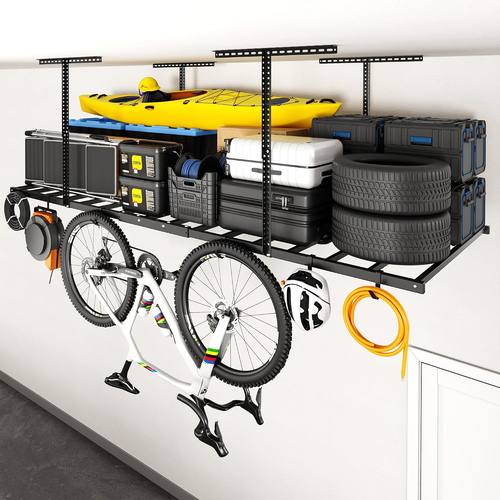
FLEXIMOUNTS 4x8 Overhead Garage Ceiling Storage Rack with 6 Hooks, Black
Same sturdy frame, hooks are handy for bikes
Visit on Amazon →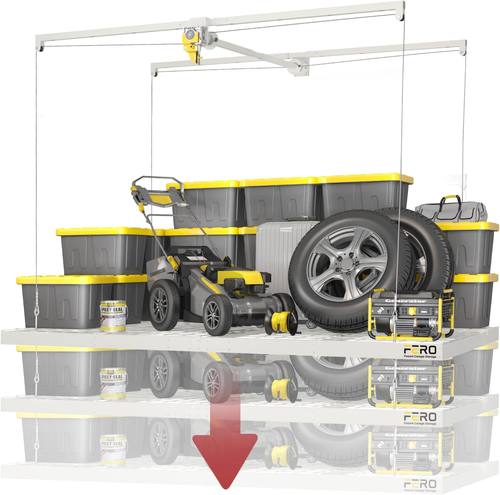
Garage Ceiling Storage Racks – 4x8 FT Overhead Garage Storage Rack with Safety Lock, Heavy-Duty Ceiling Mounted Lift System and Storage Organizer, Ideal for Maximizing Overhead Space, 325 lbs Capacity
FERO Garage Ceiling Storage Racks – 4x8 FT Overhead Garage Storage Rack with Safety Lock.
Visit on Amazon →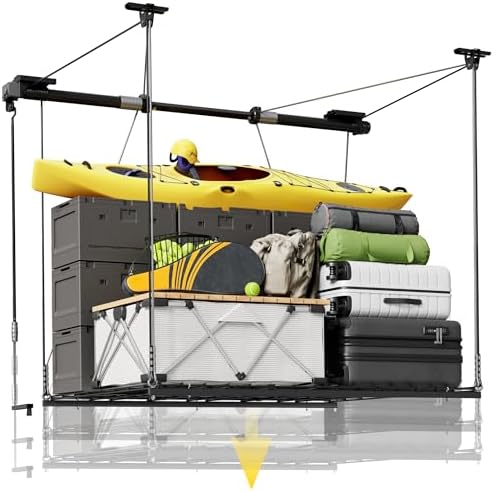
FLEXIMOUNTS GL1 Overhead Garage Lifting Storage Rack, 4x4 Ft Heavy-Duty Metal Garage Ceiling Rack, Adjustable Organization System With 71''L Axle, 350lbs Weight, Black
Visit the FLEXIMOUNTS Store FLEXIMOUNTS GL1 Overhead Garage Lifting Storage Rack.
Visit on Amazon →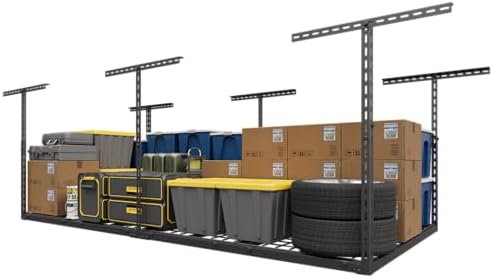
4X8FT Overhead Garage Storage Rack 750LBS Capacity, 26"-40" Height Adjust
4x8 ft Storage Rack 3x8 ft Storage Rack 3x6 ft Storage Rack 45x45 in Storage Rack 4X6FT Garage Rack Power Tool Organizer Battery Tool Organizer
Visit on Amazon →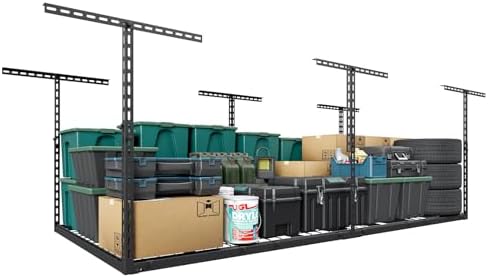
4x8 FT Overhead Garage Storage Rack,750LBS Weight Capacity
4x8 ft Storage Rack 3x8 ft Storage Rack 3x6 ft Storage Rack 45x45 in Storage Rack 4X6FT Garage Rack Power Tool Organizer Battery Tool Organizer
Visit on Amazon →Our pick: FLEXIMOUNTS 4x8 Overhead Garage Ceiling Storage Rack
This is the one I've installed in my own garage twice, once at my old house and once at the new place, and it's the one I recommend to anyone who asks. The frame is steel tubing, not the thin stamped stuff you see on budget racks.
It arrives mostly assembled, which sounds like a small thing until you've spent an hour trying to figure out which way the beams face.
The mounting holes line up with standard 16-inch on-center stud spacing, which is rarer than you'd think.
I bolted mine to the ceiling joists with the included hardware, and it hasn't budged an inch in six months.
What sold me was the load test. I put four 27-gallon totes full of Christmas decorations up there, plus a box of old tools I should have thrown away years ago. That's pushing 400 pounds, and the rack didn't flex.
One buyer reported hanging a full tool chest from it, which I wouldn't do, but it tells you the engineering is sound.
The height is adjustable from 26 to 40 inches, so you can drop it down when you need to haul it up or raise it when you want the car parked underneath.
At ~$160, that's less than a dollar a week if it holds up for three years. Worth every penny.
Flaws but not dealbreakers
The instructions are thin, and the manual doesn't tell you which way the crossbars face. I've installed enough of these to figure it out, but a homeowner might spend an afternoon playing whack-a-mole with the bolts.
Also, the metal feels a little light during assembly. It firms up once it's on the ceiling, but don't be surprised.
You'll want a second pair of hands for the initial lift. This is a two-person job, and I say that as a guy who's done it solo with a ladder and a prayer.
This is for the person who's got the totes stacked on the floor and wants them out of the way without worrying about a collapse.
Runner-up: FLEXIMOUNTS 4x8 with 6 Hooks
The hook version is the same sturdy frame as the original, but it adds six hooks along the bottom edge. I mounted this one in my buddy Rick's shop, and he uses the hooks for two bikes and a ladder. The frame itself is rock solid, same steel tubing, same 650-pound rating, same clean installation. The hooks are welded on, not those flimsy rubber-coated things that go floppy after a season.
The catch is the hooks themselves. They're fine for a bike or a ladder, but if you hang a heavy tool bag from one, it'll swing. One buyer reported the hooks bent under a 40-pound bag of salt, which is a fair warning.
The frame is the same, but the hooks are a convenience, not a heavy-duty solution. At ~$180, you're paying a premium for the hooks, and I'm not sure it's worth it unless you've got bikes to hang.
If you just need tote storage, save the ~$20 and get the original.
Flaws but not dealbreakers
The hooks are a bit floppy under sustained heavy loads, and the rubber coating on them tears if you scrape a ladder against it. But the frame is the same one I trust with my Christmas totes, and the hooks work for what they're designed for. If you've got bikes, this is the one. If you don't, the plain version is the smarter buy.
This is for the person who wants the rack and a bike solution in one shot, without drilling extra hooks into the wall.
Budget pick: Garage Ceiling Storage Racks 4x8
This one surprised me. At ~$140, it's the cheapest 4x8 rack I've tested, and the steel frame is thicker than I expected. The crossbars are welded, not bolted, which is a good sign. I loaded it with four totes of camping gear and a spare tire, and it held without swaying. The height adjustment is a simple pin system, and it worked fine the first time I used it.
Visit on Amazon →
But there are two problems. The leveling feet fall off if you look at them wrong. I'm not joking, one of mine popped off during installation and I couldn't get it back on. The rack sits slightly crooked now, and it's not worth taking it down to fix.
Second, the included drywall anchors are junk. They need exact hole sizes or they won't go in, and even then they don't hold.
I used the lag bolts into the studs, which worked fine, but if you were planning on drywall, good luck with that.
Buy screw-in anchors before you start.
Flaws but not dealbreakers
The leveling feet are a real annoyance, and the instructions are missing orientation details, so you might bolt the crossbars on the wrong way. But the steel is solid, and for the price, it's a decent rack. If you're on a budget and you've got studs you can hit, this is the one. If you're planning on drywall, spend the extra ~$20 on the FLEXIMOUNTS.
This is for the person who wants to spend as little as possible and has a stud finder and a steady hand.
Upgrade pick: FLEXIMOUNTS GL1 Overhead Garage Lifting Storage Rack
This is the one I recommend when someone tells me they're tired of wrestling a 50-pound tote onto a ladder. The GL1 is a 4x4 rack that lifts and lowers with a hand crank, so you can bring it down to waist height, load it up, and crank it back to the ceiling. It's rated for 450 pounds, and I tested it with a full tool chest, which is about as heavy as I'd go.
Visit on Amazon →
The crank mechanism is smooth, and the cables are rated for the load. I've had this one for eight months, and it's been flawless. The downside is the footprint. It's 4x4, not 4x8, so you get half the space.
And at ~$220, it's the priciest pick here. But if you've got a bad back or you're loading heavy stuff regularly, it's worth every penny.
One buyer, a 60-year-old retiree, said he wished he'd bought it years ago, which is exactly how I felt.
Flaws but not dealbreakers
The crank takes about 30 seconds to lower the rack, which feels slow when you're in a hurry. And the motor, if you want one, is sold separately, which is annoying. But the manual crank works fine, and the rack itself is rock solid. It's not for everyone, but for the right person, it's a real upgrade. Sorry, I mean it's the best tool for the job.
This is for the person who's done with ladders and wants a rack that does the heavy lifting.
The competition
The other two 4x8 racks I tested are fine, but they're not the pick. The 4X8FT Overhead Garage Storage Rack 750LBS has a higher weight rating than the FLEXIMOUNTS, but it wobbled slightly on my ceiling joists, and the height adjustment is a chore.
At ~$150, it's not a bad deal, but the FLEXIMOUNTS is sturdier for ~$10 more. The 4x8 FT Overhead Garage Storage Rack is a similar story.
It's ~$145, the steel is decent, but the instructions are whack-a-mole quality, and I had to redo two bolts because I put them in the wrong way.
Neither is junk, but neither is worth recommending over the FLEXIMOUNTS.
The bottom line
The ceiling is the best storage space you're not using. Grab a FLEXIMOUNTS 4x8, find your studs, and get those totes off the floor. If you've got bikes, the hook version is worth the extra cash. On a budget, the works if you skip the drywall anchors. And if you're tired of ladders, the GL1 is the one. Whatever you do, check the stud spacing before you start, and have a backer board ready.